

Changing for Climate is a series featuring everyday Edmontonians, businesses and organizations who are actively Changing for Climate—and getting us closer to our goal of net-zero greenhouse gas emissions by 2050. For more information, visit edmonton.ca/ChangingForClimateSeries.
Hydrogen is the most abundant element in the universe, and could be the key to unlocking a zero-emissions future.
In Edmonton, the biggest sources of greenhouse gas emissions come from the energy used to heat buildings and power our transportation and industry. According to Greg Caldwell, Director of Hydrogen at ATCO, 80 per cent of that energy comes from liquid or gaseous fuels such as natural gas and gasoline.
“We need hydrogen to decarbonize that whole section of the energy pie,” says Caldwell.
Green, blue and grey hydrogen
Hydrogen gas is colourless, odourless and tasteless. It’s highly flammable and when it burns the flame is almost invisible to the naked eye. On Earth, hydrogen most commonly exists in water and organic compounds, which are very stable under normal conditions.
It takes energy to produce hydrogen gas (H2), and how it’s produced is key to understanding how hydrogen fits into a net-zero economy.
“Hydrogen is a gas, it’s a zero-carbon energy carrier, and it allows us to deliver zero-carbon energy to our customers,” says Caldwell.

Hydrogen can be produced through a variety of methods across Canada, based on unique regional strengths and natural resources.
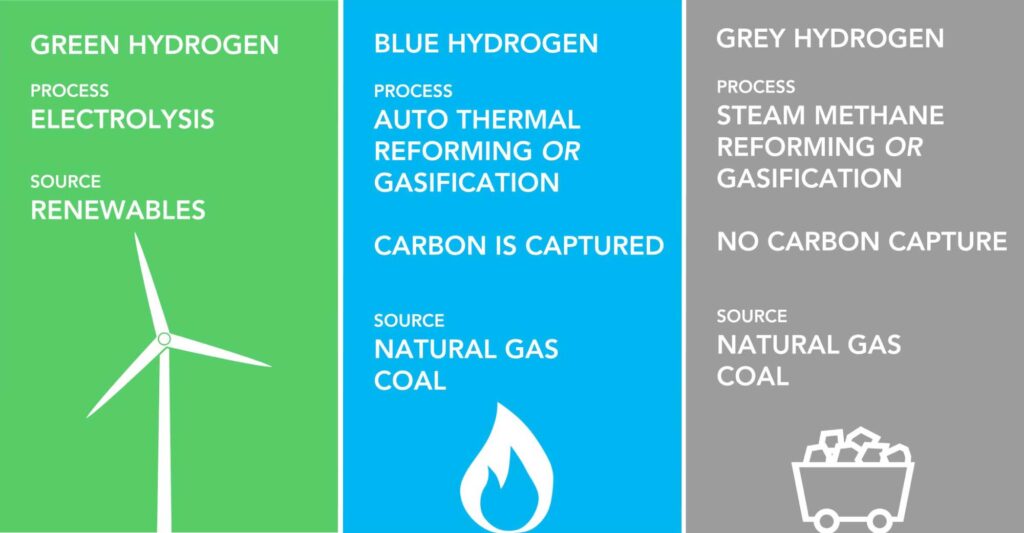
Each production method is given a different colour to indicate how it’s created, including green, blue and grey to name a few.
Green hydrogen is produced with emissions-free renewable energy, like wind or solar by electrolysis (water splitting).
Meanwhile, blue hydrogen is of particular interest in Alberta given the abundance of natural gas resources. The process to create it is similar to grey hydrogen, but up to 98 per cent of the carbon byproduct can be sequestered underground using carbon capture and storage (CCS) technology.
Grey hydrogen is made from natural gas or coal, with no carbon capture technology. This is the least environmentally friendly process since the carbon is released into the atmosphere.
To learn more about other ways to produce hydrogen, visit Natural Resources of Canada.
Planes, trains and trucks
Caldwell says the big opportunities for hydrogen to help on our journey to net-zero are in heavy industry, “things like steel production, fertilizer production and as a liquid fuel.”
It’s pretty easy to make cars electric—automakers are already investing over $500 billion in hundreds of new models due on the market in the next few years.
But when it comes to heavy transport vehicles like trains, planes, long-haul trucks and ships, “direct electrification with batteries is challenging,” says Caldwell.
So the City of Edmonton is working with surrounding municipalities and many companies in the Edmonton Region Hydrogen Hub to create infrastructure solutions for a hydrogen-powered future.
There is currently a pilot program to build a hydrogen fuelling station in Edmonton and begin running hydrogen-powered trucks on a 700-kilometre route in Alberta.
ATCO is also working with Canadian Pacific to build fuelling stations and pilot a locomotive with hydrogen fuel cells.
Hydrogen heating for homes
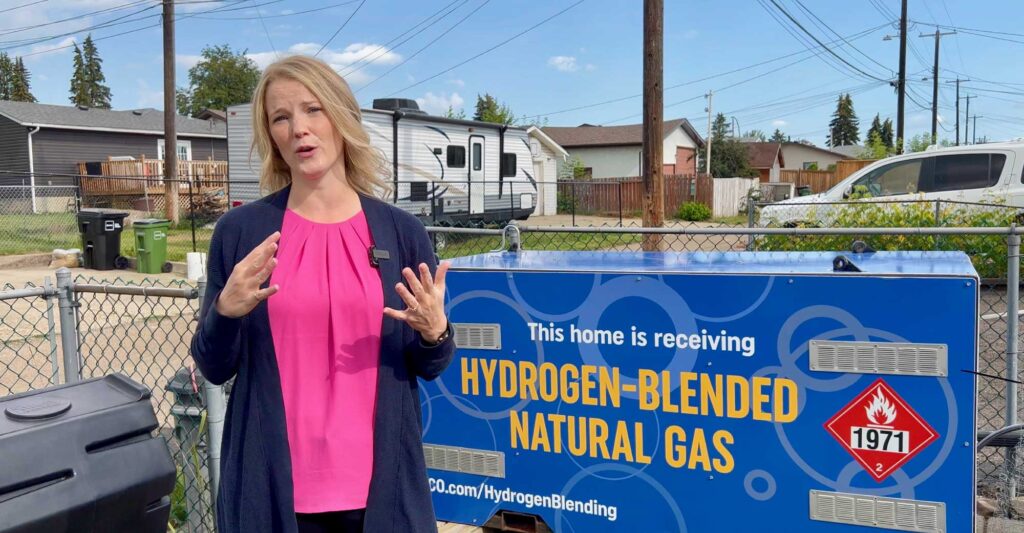
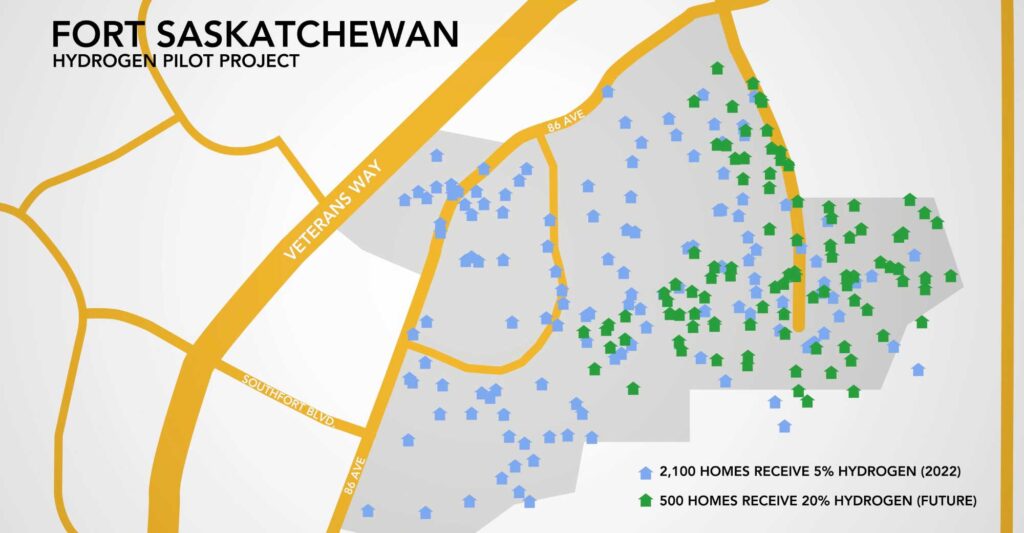
ATCO, a major natural gas utility, believes hydrogen can be used to eliminate emissions from home heating. They’re running the first large-scale pilot program to provide homeowners with hydrogen-blended natural gas this year in Fort Saskatchewan, Alberta.
“We’re going to blend between five and 20 per cent hydrogen into that community to start the process of decarbonization of the heat energy that is delivered to the city,” says Caldwell.
Renewable energy will power an electrolyzer to produce hydrogen on-site. In the first phase of the pilot, 2,100 customers will receive natural gas blended with five per cent hydrogen. In the second phase, 500 customers will receive a blend of 20 per cent hydrogen.
ATCO has done extensive testing on natural gas appliances and found there’s little difference in performance with hydrogen blends of less than about 30 per cent.
The pilot will reduce emissions from home heating by up to 10 per cent, but getting to net-zero will require more.
“We have yet to do a 100 per cent hydrogen community. However, we’ve started the work in producing an appliance that can use 100 per cent hydrogen,” says Caldwell.
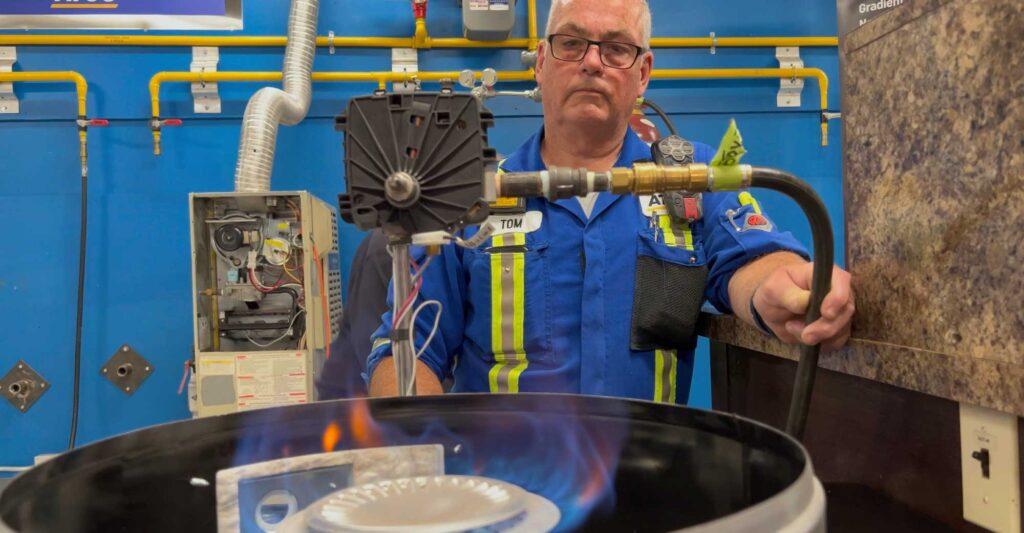
Gradient Thermal is a Calgary company that makes energy-efficient combined furnaces and hot water systems. They’re developing new models that run on pure hydrogen.
“We’re very confident that our network can use and deliver 100 per cent hydrogen to communities in the future,” says Caldwell.
The home heating challenge
Caldwell says there are only a few options for eliminating emissions for home heating.
“When you look around Canada, there’s the electrification solution, like a ground source or air source heat pump, and then hydrogen or other renewable gases,” says Caldwell.
Geothermal is already being used in many homes, which combines underground loops to harvest the heat of the Earth with a heat pump. In Edmonton, Blatchford has a district geoexchange heating system that replaces natural gas for home heating.
“I think both solutions have great pros and a few cons. Ultimately, if you’re that developer, it’s going to come down to cost and the carbon emissions; those are the two things you’re trying to balance,” says Caldwell.
Editor’s note: the pic at the top of the post shows blue flames from a hydrogen-powered appliance.