

Changing for Climate is a series featuring everyday Edmontonians, businesses and organizations who are actively Changing for Climate—and getting us closer to our goal of net-zero greenhouse gas emissions by 2050. For more information, visit edmonton.ca/ChangingForClimateSeries.
Jena and Jesse Tufts bought a 1953 semi-bungalow in Edmonton’s beautiful and mature Westmount neighbourhood. They loved the tree-lined streets, access to the river valley and the many local services. Both Jena and Jesse also enjoyed cycling to work, living out their version of a 15-minute community (take a listen to Episode 4 of the Making Space podcast).
But, like so many older homes, their bungalow needed some work. The shingles needed to be replaced and the home was so poorly insulated that, at night, their sleeping blankets would freeze to the walls in the winter—they needed to do something.
So, while they loved their home’s location, there was some work to be done on the house.
They looked into their options. The Tufts weren’t interested in moving to the suburbs to build a new home. Knocking down the house to build a new infill was just too expensive. Finally, they learned it would cost half as much to renovate the existing house, reusing the foundation and main floor.
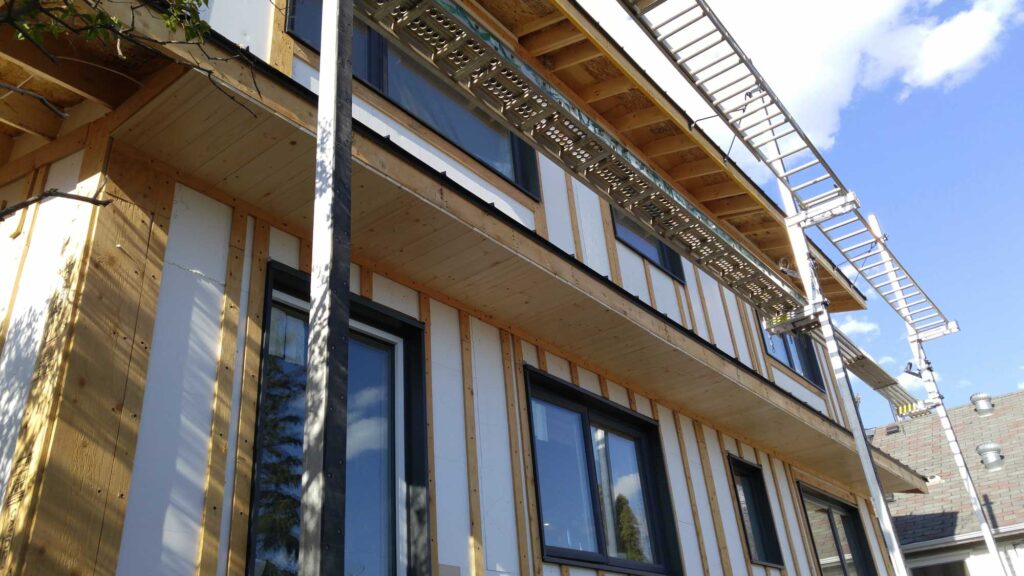
They took the plunge and removed the entire second floor and transformed their semi bungalow into a two-story home, using the same foundation.
Cheaper to retrofit
It was important to Jena and Jesse to have their own climate-ready home—a well-insulated, energy efficient home that could be powered and heated by their own solar system.
As we learned in Episode 7 of Changing for Climate, the steps to a net-zero home are:
1. Getting a home evaluation.
2. Make it tight and insulate right.
3. Add net-zero ready heating and cooling.
4. Generate your own renewable electricity.
As an engineer, Jesse didn’t shy away from doing his homework for this project. He was keen to learn how to use Hot 2000 energy modelling to evaluate their plans. This software determined how much insulation was needed, how tight the home needed to be and how much energy was needed to heat the home.
At the time of the retrofit, Jesse worked for a windows manufacturer, cutting out sections of insulated doors to insert windows into them. Instead of having the door cut-outs go to waste, he came up with a plan to reuse them in his home retrofit project.
Insulation is key
They reinsulated the existing 2×4 walls, added three layers of door cut-outs and then sealed it up tight. The new walls boast an insulation value of R44. That’s three times the insulation levels of the original walls! This meant they could heat their home with a very efficient air source heat pump that runs on electricity instead of natural gas.
“I realized we needed about four hair dryers to heat the house at minus 30,” says Jesse.
As a bonus, when the heat pump reverses its cycle, it provides air conditioning. When Jesse ran the numbers, he found he could cool their entire home for less than the cost of a traditional air conditioner cooling only one room!
All by design
The Tufts home was the second-ever home in Canada to be certified under the Canadian Home Builders Association Net-Zero Retrofit Program.
They took their time planning the retrofit and came up with a unique design that created a spacious second floor, with a beautiful roof-top deck.
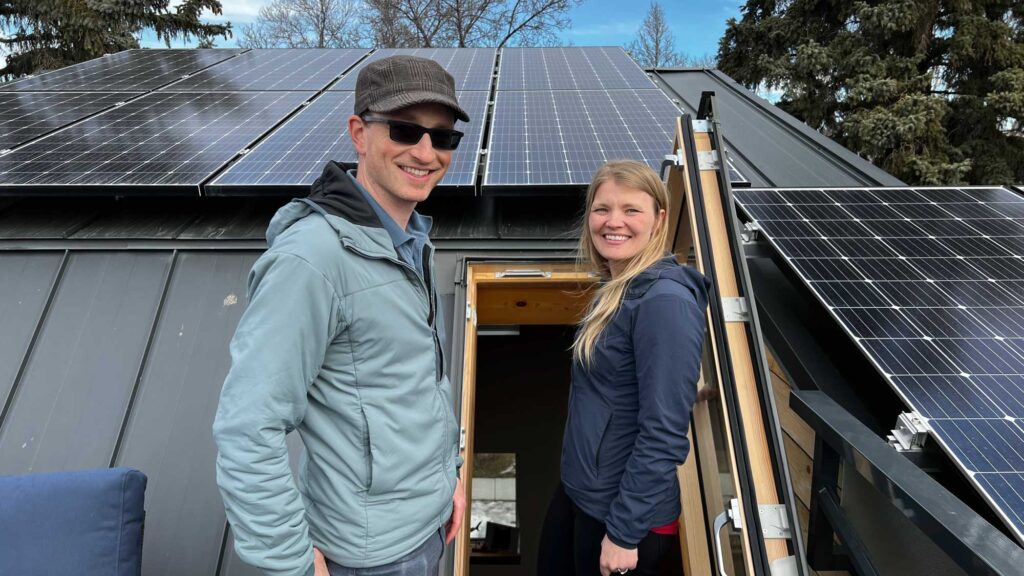
Sitting on their deck, you’re surrounded by 36 solar modules which provide all of the electricity needed to heat and power their home and charge their electric car.
Jesse says the expensive parts of the renovation were adding the roof-top deck, the front veranda, steel roofing and fire-resistant siding.
“The additional insulation, the heat pump—the efficiency part of it—was maybe 15 per cent of the overall cost,” says Jesse.
Editor’s note: the pic at the top of the post shows Jena and Jesse Tufts on their rooftop patio surrounded by solar panels.