

With a goal of reaching net-zero greenhouse gas emissions (GHGs) by 2040, the City is working aggressively to increase energy efficiency and reduce energy consumption and emissions wherever it can. These efforts have led to four recent building projects achieving LEED Certification, including:
• Stanley A. Milner Library
• Edmonton Police Service Northwest Campus
• Fort Edmonton Park Indigenous People’s Experience Cultural Centre
• Kathleen Andrews Northeast Transit Garage
LEED stands for Leadership in Energy and Environment Design. It is the most widely-used green building rating system in the world, available for virtually all building, community and home projects.
Buildings are responsible for a significant amount of global energy use, resource consumption and greenhouse gas emissions. Green buildings offer us a better quality of life (delivering buildings that offer occupants the optimal conditions for health, comfort and productivity), while also lowering global carbon emissions, reducing electricity and water bills, and creating new green jobs.
The LEED rating program is a tiered credit-based system that awards points based on compliance with different aspects of sustainability. The City of Edmonton is excited to lead the way when it comes to building and all City-owned new construction projects must meet LEED Silver rating at minimum.
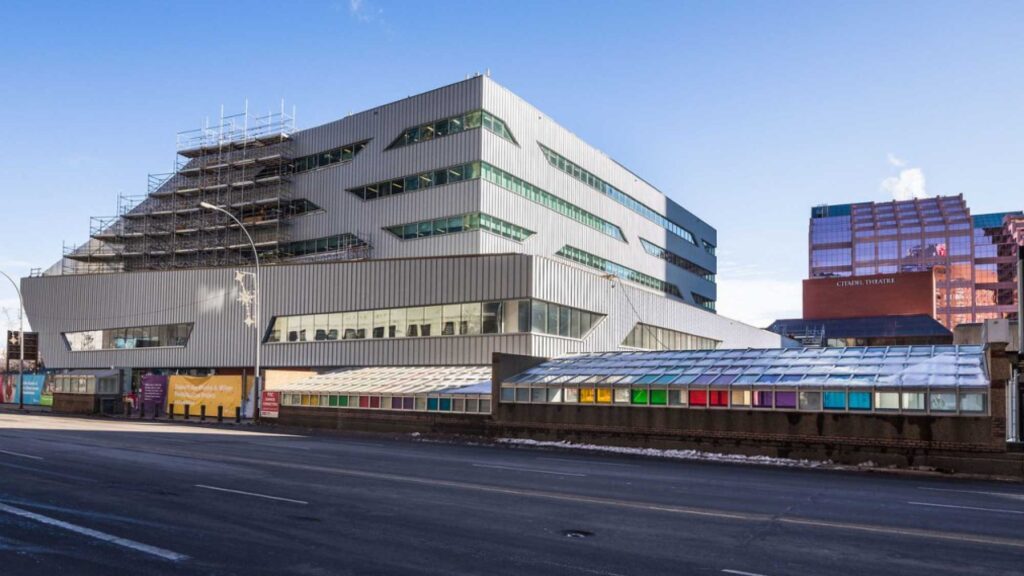
Fast facts: Stanley A. Milner Librar
Since the majority of a building’s embodied carbon is accounted for by the foundation and structure, the City opted to reuse the existing floors, columns and roof structure. The stripping down to floors and walls, as well as reconfiguring interior spaces, took significant effort and made a great impact in lowering carbon emissions.
• 93 per cent of waste was landfill diverted.
• Reroofed using High Albedo materials (materials that can reduce air conditioning load requirements and urban heat island effect).
• Demonstrates 27 per cent energy cost savings.
• Has updated connections to alternative transportation.
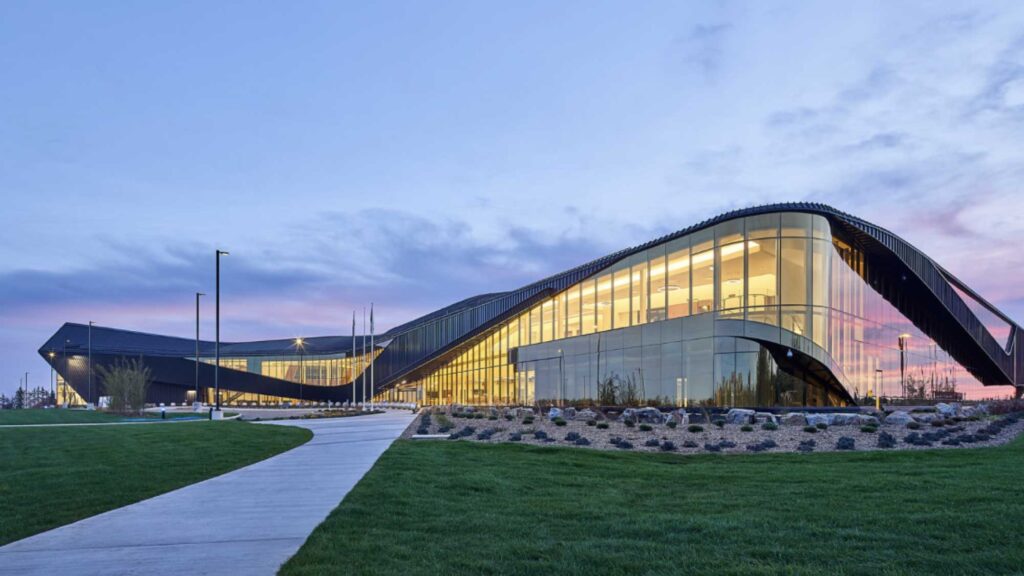
Fast facts: Edmonton Police Service Northwest Campus
• Water-efficient landscaping is achieved with drought-tolerant and native plantings.
• Modelled energy cost savings will be 45 percent.
• The total predicted energy consumption is 9,934,882 megaJoules per year for electricity and 12,289,820 MJ per year for natural gas.
• 96 per cent of waste was diverted from the landfill achieving an exemplary performance credit.
• 21 per cent of material used on the project was derived from recycled content.
• The facility achieved 21 per cent water-use reduction.
• Low-emitting paint, floor systems and composite wood are installed throughout to achieve Indoor Environmental quality credits.
• Over 75 per cent of all furniture and seating used low emitting materials, aiding in indoor environmental quality for the facility.

Fast facts: Fort Edmonton Park Indigenous People’s Experience Cultural Centre
• Achieves 50 per cent more energy efficiency than the National Energy Code of Canada for Buildings (NECB) 2011.
• Achieves 41 per cent (or greater) greenhouse gas reduction than the NECB 2011 reference building.
• Has a predicted annual heating demand of 75.6 kilowatt hours per square metre, which is less than 80 kWh/m2 as required by City policy.
Fast Facts: Kathleen Andrews Transit Garage
• The first garage in Edmonton to accommodate 30 of the City’s 40 new electric buses. Modifications were made to accommodate the needs of electric buses, which included reinforced concrete floors to bear the weight of the buses, an additional emergency generator and charging stations.
• The roof is reinforced to support future installation of solar panels. Supplemental power from the solar photovoltaic panel installation will be used to power the charging stations for the electric buses.
• The entire building was designed to be LEED Silver certified and relies solely on LED lighting, which means it’s much more energy efficient, saves money and lowers emissions.
• The roof was designed to collect rainwater, which is held in a 1.5 million litre cistern, for a bus wash system. That’s the equivalent to 7,500 household rain barrels of rainwater.
• The project was awarded the Canadian Urban Transit Association’s 2020 Corporate Leadership Award for Environmental Sustainability.
Editor’s note: the pic at the top of the post shows the Kathleen Andrews Transit Garage.