

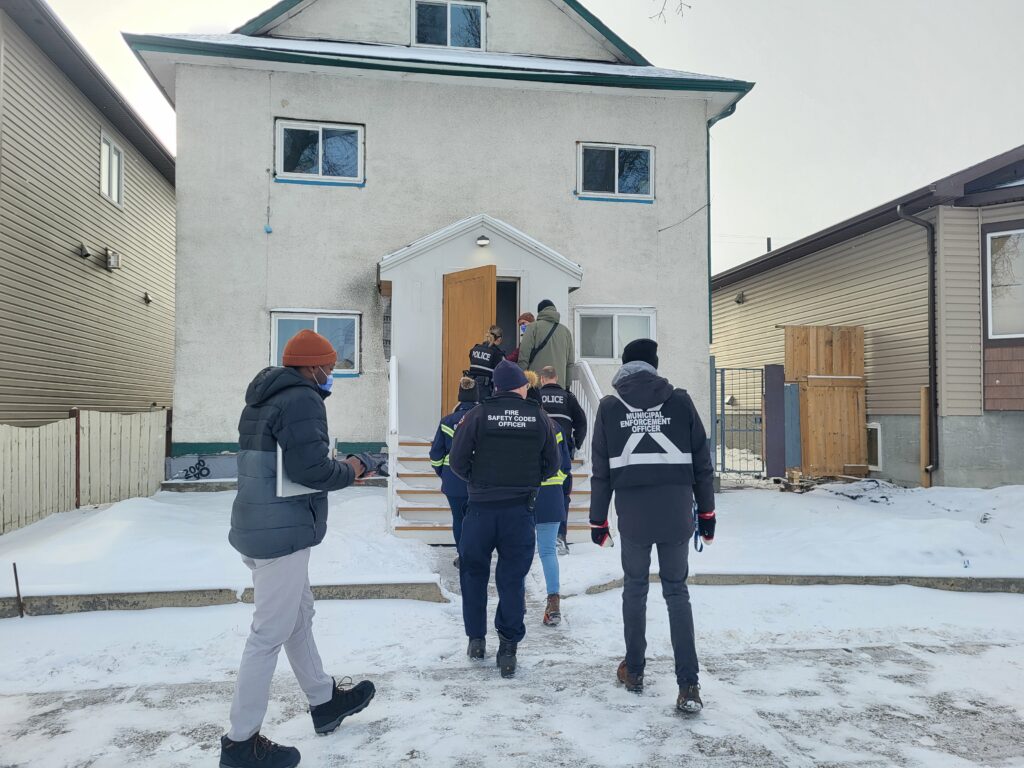
Christie Smith stands outside a residential building, preparing to meet the individuals living inside.
She’s a Community Safety Liaison working with the City’s Residential Inspection Safety Compliance (RISC) Team. RISC works to uphold minimum housing standards at high-risk properties and to reduce impacts in the surrounding community. The team provides a coordinated multi-agency approach to complex residential living situations involving vulnerable individuals, families and places.
Christie’s civilian clothes set her apart from her uniformed team members. She is not an enforcement officer or an inspector. She’s a registered social worker who offers support to people staying in or working at problem properties.
“My role is to assess the needs of vulnerable individuals and provide connections to resources and services that help meet their basic needs and enhance their overall social well-being,” says Christie.
At every visit, Christie takes an individualized, human-centred approach. that addresses the specific needs of each tenant.
“Every individual is unique,” she says. “Sometimes I’m aware of the challenges an individual is facing in advance of the first visit. But most of the time, I don’t know what to expect. One individual might need a connection to income support or health-care assistance. Another may have challenges with hoarding disorder. And, in the context of problem properties, many folks need support to leave an unhealthy living situation and access safe and secure housing.”
This dynamic work requires Christie to employ a variety of skills, including active listening, patience, advocacy, and, above all, empathy. It also requires a knowledge of Edmonton’s broad network of social agencies—knowledge which she has acquired through years of work with Edmonton John Howard Society, Bissell Centre and Sage Seniors Association.
“On an initial visit, I only have a short time to gain an understanding of an individual’s experiences and the challenges they’re facing and try to build enough trust for them to allow me to support them,” says Christie.
“An individual’s participation is voluntary. I work with some people for a few days and others for several months. Sometimes my support is very direct and hands-on and other times I’m a conduit to longer-term supports.”
Currently, Christie is working with Susan (not her real name), a homeowner in her 80s who depends on seniors benefits to meet her monthly expenses. After an unexpected decrease in her benefits, Susan was forced to take on a tenant. Unfortunately, the tenant’s behaviour led to the intervention of the RISC team.
“When I met Susan she was isolated from support and unable to navigate the system to understand the decrease in her benefits,” explains Christie. “In speaking with Service Canada, we determined that an error had been made in filing Susan’s 2022 taxes. Her income had mistakenly been entered twice and her benefits had been reduced.”
After succeeding in having Susan’s benefits returned to their correct amount, Christie helped Susan file her 2023 tax return. Christie is now supporting Susan to complete her application to use Drive Happiness, a transportation service for seniors which will reduce her transportation expenses by approximately 80 per cent.
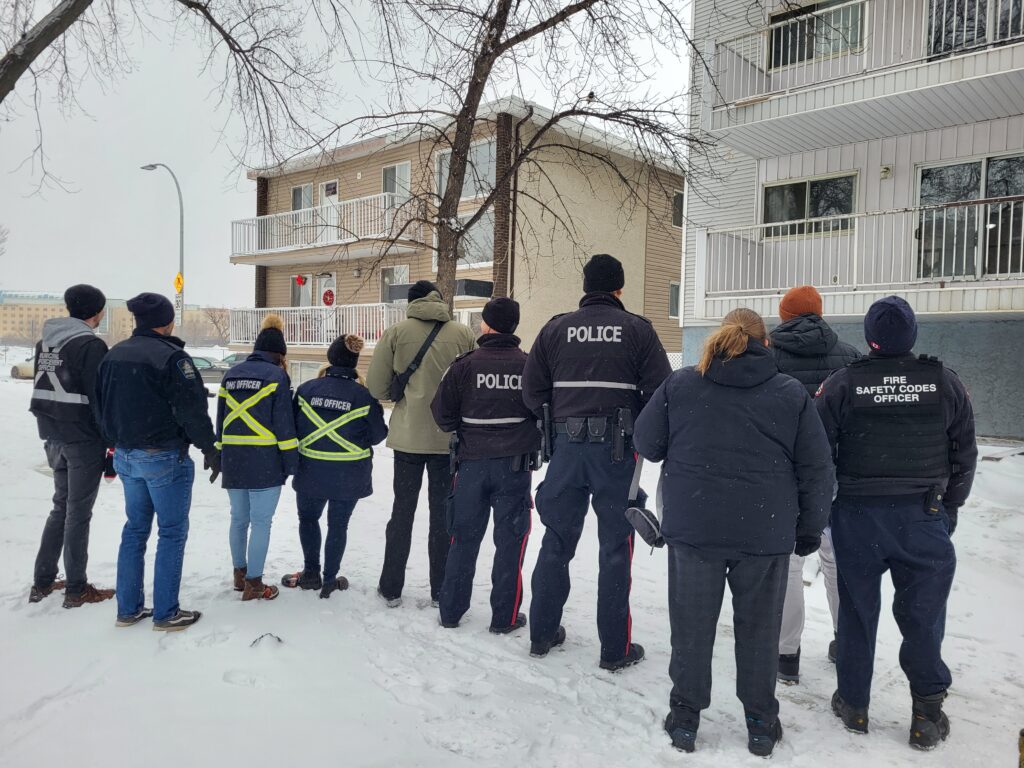
Bruce (not his real name) is another of Christie’s clients. Also in his 80s, Bruce was renting a suite in a building that was very poorly maintained by its owners. Various safety and health violations at the property led to the intervention of the RISC team, who learned that the company that owned the building was dissolved, the property was being sold, and the tenants were being evicted.
“When I met Bruce he had less than two weeks to find another place to live,” says Christie. “I arranged an interview for him with GEF Seniors Housing, and supported him at the interview. Unfortunately, there were no GEF units available before Bruce’s eviction date. Then, to complicate the situation, the property Bruce was preparing to leave caught fire and he was forced to move immediately.”
Christie succeeded in locating a space that Bruce could move into quickly, then began helping him replace the furniture that had been damaged in the fire.
“Bruce’s insurance company told us that most of his furniture was to be replaced,” explains Christie. “So I set him up with an inflatable mattress and connected him with FIND furniture, a social enterprise of Homeward Trust Edmonton that offers essential furnishings free of charge to folks who are transitioning out of homelessness.”
Over the first five months of her work as a Community Safety Liaison, Christie has supported 51 unique individuals to overcome a variety of challenges. Her human-centric role is an important part of the overall work of the RISC team, ensuring that the people in need are connected to services and transitioned into healthier and safer environments.
In 2023, RISC conducted 2031 inspections at 207 properties citywide, with a significant number of these being located in the core neighbourhoods of McCauley, Alberta Avenue, and Central McDougall.
The RISC team’s membership includes five City departments, Alberta Health Services, Edmonton Police Service, and three Government of Alberta areas. Each partner plays a unique role and brings different strategies and legislation to the team. This helps the team to take a wraparound approach that addresses a variety of issues related to problem properties.
RISC’s work is part of Edmonton’s Problem Property Initiative. In December of 2022, City Council approved permanent funding to implement the City’s long-term strategy to address properties that cause frequent and serious safety concerns and complaints to the City.
In developing the strategy, the City took into consideration the perspectives of tenants, landlords, enforcement partners, and community members. This research revealed that the City’s approach to problematic residential properties would benefit from the inclusion of a Community Safety Liaison—Christie’s position—at property inspections.
Editor’s note: the pic at the top of the post shows Community Safety Liaison Christie Smith.
To learn more about the Problem Property Initiative or to report a problem property, visit edmonton.ca/ProblemProperties or call 311.